
The Gatekeeper: Continuous Integration
Last updated on 2026-02-15 | Edit this page
Overview
Questions
- What happens if I forget to run the tests before pushing?
- How do I ensure my code works on Windows, Linux, and macOS?
- How do I automate
uvin the cloud?
Objectives
- Create a GitHub Actions workflow file that lints and tests on every push.
- Configure the
astral-sh/setup-uvaction for cached, high-performance CI. - Define a test matrix to validate code across multiple Python versions and operating systems.
- Connect CI to the release pipeline from the Release Engineering episode.
The Limits of Local Hooks
In the Quality Assurance episode, we installed prek to run ruff
before every commit. That is a good first line of defence, but it has
gaps:
- A collaborator can bypass hooks with
git commit --no-verify. - Hooks only run on your machine, with your operating system and Python version.
- If it works on your MacBook but breaks on a colleague’s Linux cluster, you will not find out until they complain.
Continuous Integration (CI) closes these gaps by
running your test suite on a neutral server every time code is pushed.
It is the “gatekeeper” that protects the main branch.

Anatomy of a Workflow File
GitHub Actions reads YAML files from .github/workflows/. Each file describes
when to run (on),
what machine to use (runs-on), and what commands to
execute (steps).
Let’s create our gatekeeper. Start by making the directory:
Now create .github/workflows/ci.yml
with the following content. This mirrors exactly what we did locally in
the Quality Assurance episode: lint, then test.
SH
name: CI

on:
  push:
    branches: [main]
  pull_request:

jobs:
  check:
    name: Lint and Test
    runs-on: ubuntu-latest
    steps:
      - name: Checkout Code
        uses: actions/checkout@v4

      - name: Install uv
        uses: astral-sh/setup-uv@v5
        with:
          enable-cache: true

      - name: Set up Python
        run: uv python install 3.12

      - name: Install Dependencies
        run: uv sync --all-extras --dev

      - name: Lint
        run: uv run ruff check .

      - name: Format Check
        run: uv run ruff format --check .

      - name: Test
run: uv run pytest --cov=srcThe astral-sh/setup-uv action installs
uv and (with enable-cache: true) caches the downloaded
packages between runs. This makes subsequent CI runs significantly
faster than a fresh install each time.
Challenge: Reading the Workflow
Before we push anything, make sure you understand the structure. Answer the following:
- Which event triggers this workflow on a pull request?
- What operating system does the job run on?
- Why do we use
ruff format --checkinstead ofruff format?
- The
pull_requesttrigger (underon:) fires whenever a PR is opened or updated against any branch. -
ubuntu-latest(a Linux virtual machine hosted by GitHub). -
--checkexits with an error if files would be reformatted, without actually modifying them. In CI we want to detect problems, not silently fix them. The developer should runruff formatlocally and commit the result.
The Test Matrix
The workflow above runs on one OS with one Python version. That is better than nothing, but one of the biggest risks in scientific Python is compatibility.
- A script might work on Linux but fail on Windows due to path
separators (
/vs\). - Code might work on Python 3.12 but fail on 3.11 because it uses a
feature added in 3.12 (like
typestatement syntax). - A filename like
aux.pyis perfectly legal on Linux but reserved on Windows.
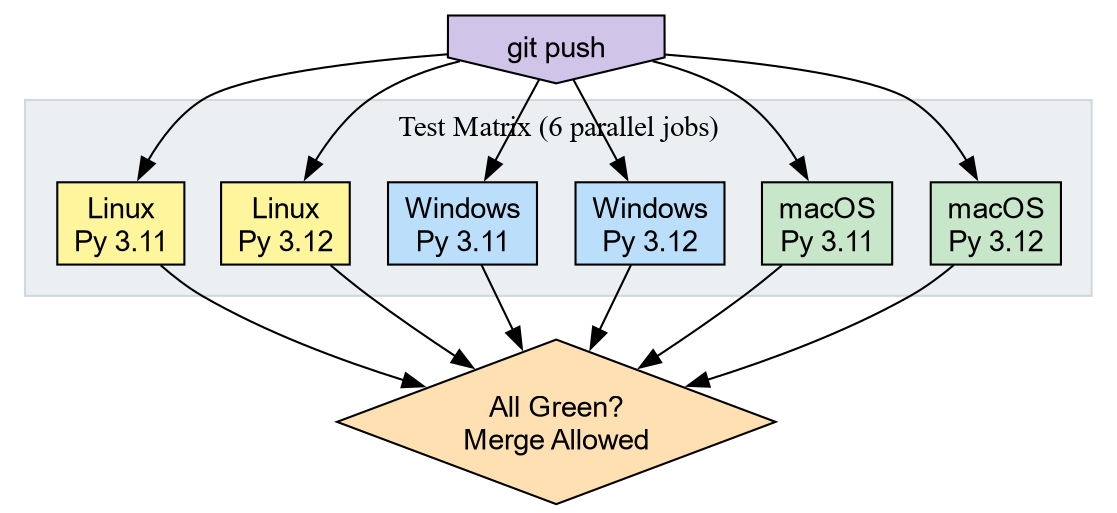
A Matrix Strategy tells GitHub to run the same job across every combination of parameters. We define the axes (Python versions, operating systems) and GitHub spins up one runner per combination.
Replace the jobs: block in your ci.yml with the version below. The steps remain identical; only the job header
changes.
SH
name: CI

on:
  push:
    branches: [main]
  pull_request:

jobs:
  check:
    name: Test on ${{ matrix.os }} / Py ${{ matrix.python-version }}
    runs-on: ${{ matrix.os }}
    strategy:
      fail-fast: false
      matrix:
        python-version: ["3.11", "3.12"]
        os: [ubuntu-latest, windows-latest, macos-latest]

    steps:
      - uses: actions/checkout@v4

      - uses: astral-sh/setup-uv@v5
        with:
          enable-cache: true

      - name: Install Python ${{ matrix.python-version }}
        run: uv python install ${{ matrix.python-version }}

      - name: Install Dependencies
        run: uv sync --all-extras --dev

      - name: Lint
        run: uv run ruff check .

      - name: Format Check
        run: uv run ruff format --check .

      - name: Test
        run: uv run pytest --cov=src
Two Python versions times three operating systems gives six parallel jobs. If any single job fails, the Pull Request is blocked.

Windows uses backslash (
\) as the path separator. A hardcoded forward slash string will not resolve correctly on Windows.-
Use
pathlib.Path: The very first episode (Writing Reproducible Python), where we introduced
pathlibfor cross-platform file handling.
Connecting CI to Releases
In the Release Engineering episode, we manually uploaded artifacts to
TestPyPI with uvx twine. We also previewed
an automated release job. Now that we understand how workflows are
structured, let’s see the complete picture.
Add a second job to the same ci.yml
file. This job only runs when you push a version tag (e.g., v0.1.0) and only after the test
matrix passes.
YAML
release:
  needs: check
  if: github.event_name == 'push' && startsWith(github.ref, 'refs/tags/v')
  runs-on: ubuntu-latest
  permissions:
    id-token: write
    contents: read

  steps:
    - uses: actions/checkout@v4
    - uses: astral-sh/setup-uv@v5

    - name: Build
      run: uv build

    - name: Publish to TestPyPI
      uses: pypa/gh-action-pypi-publish@release/v1
      with:
        repository-url: https://test.pypi.org/legacy/
Key details:
needs: check- The release job waits for all six matrix jobs to pass. A broken build is never published.
id-token: write- Enables OIDC Trusted Publishing. GitHub proves its identity to PyPI directly, so you never need to store an API token as a secret.
- The tag filter
-
Only tags starting with
v(likev0.1.0) trigger the release. Normal pushes tomainrun tests but do not publish.
Challenge: The Release Workflow
Walk through the following scenario:
- You merge a pull request to
main. Does thereleasejob run? - You tag the merge commit with
git tag v0.2.0andgit push --tags. What happens now? - Imagine the
windows-latest / Py 3.11job fails. Does the release still happen?
-
No. The
if:condition requires the ref to start withrefs/tags/v. A push tomaindoes not match. - The tag push triggers CI. All six matrix jobs run. If they pass, the
releasejob runs: it builds the wheel and sdist, then publishes to TestPyPI via OIDC. -
No. The
needs: checkdependency means thereleasejob is skipped when any matrix job fails. The tag remains, and you can re-trigger after fixing the issue.
- Continuous Integration runs your test suite on a neutral server on every push, catching problems that local hooks miss.
-
astral-sh/setup-uvprovides a cached, high-performanceuvenvironment in GitHub Actions. - A Matrix Strategy tests across multiple operating systems and Python versions in parallel.
- CI can gate releases: the
releasejob usesneeds:to ensure tests pass before publishing.